
The Indian pharma industry is estimated to grow at 9-11 per cent in 2021-22 and in the next few quarters, it will be driven by domestic and emerging markets, according to ratings agency ICRA. In a sample of 21 Indian pharmaceutical companies, ICRA said revenue growth was moderate at 6.4 per cent in the second quarter of FY22, down from 16 per cent in the first quarter of 2021-22. The normalisation of the base and pricing pressures in the US market were the major reasons for slowing growth momentum in Q2 FY22, even as growth under domestic and emerging markets remained healthy, ICRA said in a statement.

Stocks of alcoholic beverage makers have corrected over the last few trading sessions on worries that taxes, competition and costs will hurt sales and profitability. The recent trigger for the decline is Karnataka, which accounts for 15 per cent of overall liquor consumption, increasing duties. The state increased by 20 per cent the additional excise duty on Indian-made foreign liquor (IMFL) on all slabs.

Indian shoppers accounted for 13 per cent of the total hours spent by mobile users across the globe on their shopping apps in 2023, next only to China in this regard. According to the "State of Mobile -2024" report released a few days ago by data.ai (previously known as App Annie), which looks into various segments of the app economy across the world, in the last calendar year, users in India collectively spent 12.84 billion hours on shopping apps. This represents an increase of over 73 per cent from the time they spent in 2020 and of more than 3.5 per cent over 2022.

While the Aam Aadmi Party is contesting on four seats, the Congress has fielded candidates for the remaining three seats.
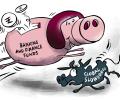
Even as banks and finance companies are reporting record-high earnings, their weighting in the benchmark National Stock Exchange Nifty50 Index has seen a downward trajectory. Investors expect a stronger performance from other sectors in the new year. Currently, banking, financial services and insurance (BFSI) companies collectively hold a weighting of 34.5 per cent, down from 36.7 per cent at the end of December 2022 and a record high of 40.6 per cent at the end of December 2019. This represents the sector's lowest weighting in the index since December 2021 when it stood at 33.7 per cent.

After being underweight on domestic agrochemical companies and preferring global plays, brokerages believe that the former may perform better in the quarters ahead. Domestic crop protection companies have faced multiple headwinds over the past year and a half, given high inventory costs, pricing pressures, lower realisations in the generic segment, increased stocks due to lower infestations, and demand-led hits to volumes. Some of the overhang from previous quarters was reflected in the April-June quarter (first quarter, or Q1) of 2023-24 (FY24) as well, with aggregate revenues and operating profit for the sector down 12 per cent and 27 per cent, respectively.

As the Indian currency hovers around its lowest versus the US greenback, several smaller and mid-sized companies are expected to face rough weather as almost 44 per cent of the foreign loans taken by Indian companies remained unhedged. According to the data sourced from the Reserve Bank of India, Indian companies raised around $38.2 billion in the financial year ended in March. Of this, only 56 per cent of the loans are hedged while the rest of the foreign loans remain unhedged, thus risking the companies to forex volatility.

The fresh meat and seafood delivery startup Licious plans to set up 500 stores nationwide within the next five years as part of an omnichannel strategy. The aim is to attract new users in the offline channel and encourage them to transact online as well. The move would also help the company in its efforts to achieve profitability and go for an initial public offering (IPO) in the next 24 months, according to the sources.

Recovering from early losses, the rupee on Friday ended marginally higher at 64.81 against the US dollar.

'Investors should ideally consider equity allocations from a medium-to-long term perspective.'

Trade generic drugs (medicines that are sold directly through distributors) are fast becoming a key segment for domestic pharma firms as volume growth slows in the overall market. Big companies like Cipla and Alkem have a significant presence in the segment but recently, players like Torrent Pharmaceuticals and Dr Reddy's Laboratories (DRL) have also entered this market. What is driving big pharma's focus on trade generics? The volume growth in the Indian Pharma Market (IPM) has come down from 5.6 per cent in FY16 to 0.1 per cent in FY23.

'For the next two years, we expect the bulk of earnings growth contribution from sectors like financials and energy, where the outlook remains positive, while the sectors which are linked to domestic consumption and are currently witnessing strains on margins have low salience for Nifty earnings.'

Rebalance your portfolio in case it has become overweight on equities vis-a-vis your strategic asset allocation.

Huge demand for dry bulk commodities such as iron ore, coal, and grain has helped the Index touch a five year high recently.

The Indian rupee on Tuesday ended marginally higher against the American currency at 61.41 amid volatile trading on the back of a higher dollar overseas.

After three consecutive years of infusing huge funds, foreign portfolio investors retreated from the Indian equity markets in a big way in 2022 with the highest-ever yearly net outflow of nearly Rs 1.21 lakh crore. The huge outflow, which surpasses by a big margin the previous record of Rs 53,000 crore net withdrawal in 2008, came amid aggressive rate hikes by central banks globally but 2023 is expected to be better on positivity about overall macroeconomic trends in India, experts said. Apart from global monetary tightening, volatile crude, rising commodity prices along with Russia and Ukraine conflict led to an exodus of foreign money in 2022.

While company would hold on to prices for now, hike likely by end of 2013

Other gainers included Kotak Bank, HCL Tech, ONGC, Asian Paints, Vedanta, HDFC Bank, Bajaj Finance, Maruti and TCS, gaining up to 1.41 per cent. Sun Pharma was the top loser, cracking 8.58 per cent.

The hope that the ongoing 13th round of negotiations towards an India-UK free trade agreement (FTA) could conclude with a deal for British Prime Minister Rishi Sunak to sign off in time for the India versus England World Cup cricket clash in Lucknow on October 29 seem to be fading, according to a UK media report on Wednesday. The Financial Times quoted officials briefed on the negotiations to say that a lack of movement towards opening up of the Indian market to British professional services in the field of law and accountancy is among the factors for the slowdown. So much so that cricket fan Sunak's proposed return visit to India after an inaugural visit as UK Prime Minister to New Delhi for the G20 Summit last month is looking "very, very unlikely to happen".

The government on Friday proposed hiking the securities transaction tax on Futures & Options (F&O) contracts, a move that will increase the trading costs in the derivatives segment as well as help in curbing excessive trades. In the Finance Bill 2023, passed by the Lok Sabha on Friday, the Securities Transaction Tax (STT) on options is proposed to be increased to 0.0625 per cent from 0.05 per cent and on futures contracts to 0.0125 from 0.01 per cent. Analysts opined that higher STT will shore up the government's revenues to some extent and also discourage excessive trading since a large number of retail traders are losing money in the segment.

Notwithstanding expectations of a pick-up in construction activity during a seasonally strong January-March quarter (fourth quarter) of 2022-23 (FY23), analysts are cautiously optimistic about the building material sector - encompassing paints, pipes, wood panels, tiles, metals, and cement - as volatile input costs, coupled with fears of a global slowdown, are making demand projections uncertain. Against this backdrop, analysts suggest investors stay selective and pick stocks of companies with stronger brand recall, expanding distribution network, diversified product profile, healthier balance sheet, and sustainable cash flow. "The government's various proposals under Budget 2023-24 (FY24) may lead to the building material segment growing between 8 per cent and 12 per cent for the next five years.

While the Indian government has been procuring Covid-19 vaccines at low prices so far, manufacturers have to declare the prices of vaccines they would supply to the open market (industries, private hospitals, etc) and state governments before May 1. Sohini Das reports.

Will Andhra Pradesh follow the Odisha model, voting differently in Lok Sabha and assembly elections? Or will Odisha follow Andhra Pradesh, voting in new faces in both?

10 stocks which are most popular with brokerages right now and are expected to deliver maximum upside over the next 12 months.

Passenger vehicle wholesales in India touched a record high of 42,18,746 units in the financial year 2023-24, registering a year-on-year growth of 8.4 per cent on the back of robust demand for utility vehicles, industry body SIAM said on Friday. As per the latest data issued by the Society of Indian Automobile Manufacturers (SIAM), the overall passenger vehicle dispatches stood at 38,90,114 units in fiscal year 2022-23. Two-wheeler sales were up 13.3 per cent last fiscal at 1,79,74,365 units, as compared to 1,58,62,771 units in the financial year 2022-23.

There hasn't been any dramatic moment in the first act (the Budget) but nobody would complain. It's par for the course as long as the figures don't change in the main Budget, which will be presented after general elections.

Indian Oil Corporation (IOC), the nation's biggest oil firm, on Tuesday reported a 31.4 per cent drop in the fourth quarter net profit as record refining margins were wiped away by a margin squeeze in petrochemicals and losses on auto fuel sales. Standalone net profit of Rs 6,021.88 crore, or Rs 6.56 a share, in January-March, compared with Rs 8,781.30 crore, or Rs 9.56 per share, in the same period a year back, the company said in a stock exchange filing. Sequentially, the profit was higher than Rs 5,860.80 crore in the previous quarter.

Reliance reported record pre-tax profit from its retail and telecom businesses. The two now account for nearly 32 per cent of EBITDA, up from close to 25 per cent previously.

The overall breadth was negative as 1,539 stocks declined while 1,232 stocks advanced.

It was a roller-coaster week for the markets, amid talk of a fiscal stimulus by the government. Saurabh Mukherjea, chief executive officer, and Prashant Mittal, strategist, at Ambit Capital tell Puneet Wadhwa the recent flows into equity mutual funds are largely speculative in nature and pose a risk of reversal.

India's second largest IT services company Infosys on Thursday reported a 3.1 per cent year-on-year rise in net profit to Rs 6,215 crore for the September 2023 quarter. The earnings (before minority interest) of the Bengaluru-based company stood at Rs 6,026 crore in the year-ago period. The company - which competes in the IT services market with TCS, Wipro, HCL Technologies and others - saw its revenue rising 6.7 per cent to Rs 38,994 crore for the just-ended September quarter.

Y M Deosthalee, chief finance officer and a member of Larsen & Toubro's board, said companies accessed the domestic market for capital requirements, which might cost them a little more.

Layoffs, corporate restructuring, governance and most importantly profitability: The 14 Indian startups that plan IPOs this year are pulling out all the stops to ensure successful market debuts.

Benchmark indices Sensex and Nifty gained around half a per cent to close at nearly five-month high levels on Monday following continuous foreign fund inflows and firm trends in Asian and European markets. Rising for a second straight day, the 30-share BSE Sensex climbed 317.81 points or 0.51 per cent to settle at 62,345.71, the highest closing level since December 14. During the day, it rallied 534.77 points or 0.86 per cent to 62,562.67.

'To the believers of crypto regulations, I have only one question to ask, how will you regulate it?'

The country's largest software exporter TCS on Wednesday reported a 16.83 per cent jump in its June quarter consolidated net profit to Rs 11,074 crore. The Tata Group company had reported a net profit of Rs 9,478 crore in the year-ago period and Rs 11,392 crore in the preceding quarter. Its revenue from operations increased 12.55 per cent on a year-on-year basis to Rs 59,381 crore and was marginally up from the preceding March quarter's Rs 59,162 crore.

Abbott India outperformed the Indian pharmaceutical market (IPM) with a year-on-year (YoY) growth of 23 per cent in February. The domestic market grew at a robust 20 per cent on a low base, primarily led by volume growth and price hikes. Abbott continued to outperform the sector in the anti-diabetic space with a growth of 20 per cent and key brands such as Thyronorm (hypothyroidism), biliary agent Udiliv, insulin Ryzodeg posted robust growth.

State-owned fuel retailers are losing close to Rs 3 per litre on selling diesel while the profit on petrol has trimmed due to recent firming up in international oil prices, industry officials said detailing reasons for continuing to hold retail prices. Indian Oil Corporation (IOC), Bharat Petroleum Corporation Ltd (BPCL) and Hindustan Petroleum Corporation Ltd (HPCL), who control roughly 90 per cent of India's fuel market, 'voluntarily' have not changed petrol, diesel and cooking gas (LPG) prices for almost two years now, resulting in losses when input cost was higher and profits when raw material prices were lower.

Spending has begun rising in infrastructure, construction and Indian firms have started to benefit.

Tyre stocks have been on a tear over the past six months, with average returns exceeding 45 per cent. Except for Apollo Tyres, which has seen a slight correction in the last month and a half, limiting its gains to 16 per cent, listed peers such as MRF, CEAT Tyres (formerly Cavi Elettrici e Affini Torino), and JK Tyre & Industries have delivered returns exceeding 30 per cent during this period. Production-related constraints and sluggish demand in Europe, where sales are expected to remain flat, coupled with high valuations, have contributed to Apollo Tyres' underperformance. The tyre sector's gains can be attributed to robust growth trends driven by the replacement market, which constitutes more than two-thirds of sales.
